Translate into your language

Dec 8, 2018

Prevention and Control of Non Communicable Diseases 20 / 24 Post (August 2018)

Key facts

  • Noncommunicable diseases (NCDs) kill 41 million people each year, equivalent to 71% of all deaths globally.
  • Each year, 15 million people die from a NCD between the ages of 30 and 69 years; over 85% of these "premature" deaths occur in low- and middle-income countries.
  • Cardiovascular diseases account for most NCD deaths, or 17.9 million people annually, followed by cancers (9.0 million), respiratory diseases (3.9million), and diabetes (1.6 million).
  • These 4 groups of diseases account for over 80% of all premature NCD deaths.
  • Tobacco use, physical inactivity, the harmful use of alcohol and unhealthy diets all increase the risk of dying from a NCD.
  • Detection, screening and treatment of NCDs, as well as palliative care, are key components of the response to NCDs.


Source:

https://www.who.int/news-room/fact-sheets/detail/noncommunicable-diseases


Nepal National Micro Nutrient Status Survey (NNMNSS) : Key findings Post 19 / 24 (July 2018)

Following 2016 Nepal DHS final report dissemination, Ministry of Health and Population (MoHP), Government of Nepal (GoN) with support from UNICEF, USAID, European Union, CDC, New Era published another key document - Nepal National Micronutrient Status Survey (NNMSS) Report 2016


Key findings:

The Nepal National Micronutrient Status Survey (NNMSS) assessed micronutrient status among representative populations in Nepal, including specifically the status of vitamins A, iron, folic acid, iodine, zinc and the condition of anemia. To assess nutritional status andunderstand factors related to micronutrient status and anemia, the survey also collected information on anthropometry, infectious diseases (malaria, Soil Transmitted Helminths (STH), Helicobater Pylori (H. pylori), visceral leishmaniasis), blood disorders, and markers of inflammation. Additionally, the survey provided information on process and outcome indicators of priority for national supplementation and fortification interventions, and other key nutrition interventions in the country. 

Source: 


Aug 27, 2018

Evidence Based Policy and Planning: Our direction for Quality and Safe health care delivery Post 18/24 (June 2018)

This week and prior week was time - spent well. In a sense, I utilised the opportunities plenty in and out of our ministry of health like interactive meetings, workshops, and sometime trainings. I also realised, as many concerned colleagues ask me regularly and i tell them that our ministry is so rich with "knowledge generating activities" as good as any universities. So, we are constantly able to bombard our "neocortex" with constant academic activities, unlike one journalised (although with good intention) recently wrote in a mainstream online news that we just arrive at office, mark our attendance and just go home. Well, that news was partly true that we are not assigned with any divisional role and responsibilities but not the whole truth. Otherwise, we are engaging regularly in various activities as I mentioned earlier. To be honest, I am enjoying this interlude of work experience from joining Ministry of Health and then assignment for Far West Regional Health Directorate and now recalled here at the ministry. It is such an interesting time to both observe and experience at the same time the implementation of federalism that this is our historical moment in the history of Nepal. 

In this climate of change, where we are partly influenced by what is called federal restructuring, I am definitely searching for an opportunity to be useful for our country. I also know that time is always victorious provided you continuously put an honest effort. In this light, I am pragmatic and share benefit of doubt balanced more towards to positive outcome in coming days. Therefore, I am of an opinion that this is an excellent time - period for reading and writing that relates to health related agenda, which is of paramount importance to our people, and in that context, our top tier health professionals need to focus in system strengthening (not fragmenting !!) and that too cemented by scientific evidences and open discussion. It is for that reason, I was fortunate to participate in an "Dialogue for Evidence Based Policy in Federal Context" organised by Policy, Planning and Monitoring Division under Ministry of Health and Population (MoHP) on 16 August 2018 and one day workshop "Evidence Based Health Policy and Planning: Our direction for Quality and Safe Health Care Delivery" organised by Nepal Health Research Council (NHRC) on 21 August 2018.

It was such an atmosphere of positive direction and excitement that Policy, Planning and Monitoring Division took an proactive role in starting the policy dialogue, which was announced that this event will be a regular monthly event in MoHP in the presence of Honorable Health Minister and Madame Secretary of Health. The dialogue went for almost 2 hours, and the topic was procurement and logistic management of medical procurement and logistics management system. The key objective of this dialogue were as following:

  1. Discuss potential approaches and modalities of medical procurement and logistics management system in the federal context
  2. Discuss on potential roles and responsibilities of the federal, provincial and local government on medical procurement and logistics management of medical products
  3. Contribute to develop evidence based policy and plan on medical procurement and logistics management (evidence - based decision making space)

In overall - I found this dialogue rewarding such that we were discussing perennial issue of bottlenecks and red tapes re: public procurement. Although this issue has been lingering in public debate since decades, the representatives from ministry of federal affairs and general administration, ministry of finance (Public Procurement Management Office), National Planning Commission (NPC) and ministry of natural resource (National Natural Resources and Fiscal Commission) took account of opinion raised by participants that life saving medical products and other commodities (like cements/pebble/vehicles etc) can be governed by the same public procurement act. Therefore, there was strong voice raised for review and revision of public procurement act as well as its regulation. Another issue that brought heated discussion was on generic prescription, which is now of agreed consensus such that rationale prescription is what people demand for quality and safe health care and there should be no compromise for quality and safety of the drugs prescribed. Finally, there was proposed various models of public procurement in the context of federal structure. However, there was not single agreed model to be instituted in the changing 3 tier government. Therefore, there was a common understanding that there is need for further extended dialogue on this discussion re: how to adapt public procurement in 3 tier governance.

The workshop organised by NHRC was even more detailed and the key message that I was able to take home was that there is not short cut to health policy and planning without robust and timely evidence base. For that, we need to strengthen health research capacity thought system strengthening and long term investment. Also, we should not forget that there is need for continuous dialogue between research organisations, universities and all sectoral ministries. We should not also forget that health is a developmental agenda, which is also global health security issue of highest importance. In this light, 21st century is the time period for evidence based science, which is undoubted backbone for our future. For more details on this workshop, please visit the Link for the presentation Slides and Group Work Resources of the workshop organised by NHRC

27 August 2018
Kathmandu

Aug 13, 2018

The Burden of Disease (BoD) and its cost implication in Nepal Post 17 / 24 (May 2018)

-->
The constitution of Nepal (20 September 2015) has envisioned fundamental rights to be enjoyed by all Nepali citizen and duties of the state to make sure that these rights are secured relating to health, food, women’s health, child, senior citizens, housing, clean environment and all those rights that are directly or indirectly related with health and wellbeing of our people. In addition, Government of Nepal is committed in achieving key indicator targets that are set in United Nations Sustainable Development Goals (UNSDGs). Current global understanding as well as consensus is that “health and wellbeing” of our people is the key developmental agenda, which needs to be incorporated in every sectors of governance within our national as well as subnational planning process with “health in all” as a guiding principle. In order to achieve these national as well as global commitments, evidence based policy making or in other words, data based decision making is the best practice that has to be enacted in our work culture to deliver affordable, safe and quality public service care and sustain its positive impact in the people’s welfare in the community.

Scientific evidences suggest that the population health in Nepal is experiencing through the double burden of diseases such that there is rise in morbidity and mortality of non communicable diseases, while national health system is still overwhelmed dealing with communicable diseases compounded by rapid rise in urbanization and its population, environmental degradation and rising cross border “migration” related health issues. 2009 BOD study in Nepal reports  a shift over time from communicable diseases (primarily pneumonia and diarrheal diseases) to non-communicable diseases (primarily heart disease, COPD, and diabetes) as being the principal drivers of health loss. While understanding trends in the epidemiologic transition is critical to addressing population health, these trends are not immediately clear without comprehensive burden estimates from all conditions. Additionally, some top DALY contributors, including low back pain, migraine, hearing loss, and major depression, are major drivers of health loss; yet, they are largely unrecognized when looking specifically at fatal outcomes. Understanding the disease profile at a national level, and eventually subnational level, is critical to making the best and most informed decisions to improve health outcomes in Nepal at both the population and individual levels. In addition, 2018 Nepal multidimensional poverty index reported that 28.6 % of Nepal’s population is “multidimensionally poor’ and these “poors” as well middle class population are burdened by Out of Pocket Expenditure (OOP), which is alarming at 55.4 % of Current Health Expenditure  (CHE) in the year 2015/16.

In the previous and the existing recently organizational structure and its functional rearrangement, all experts and leadership agree that the health information system is functioning “inadequate” and its structure is fragmented and numerous information system running parallel contrary to the global practice of integrated and efficient health informatics system, which must function as the core system within the larger health system. Therefore, there is an acute need for the establishment of Health Informatics Unit, Monitoring and Evaluation Unit, Health Economics and Research unit within Ministry of Health and Population that work in close coordination and collaboration with Planning and Policy Division within health Ministry, National Health Research Council (NHRC), Central Bureu of Statistics (CBS), and various federal and provincial academic health research institutions.

Apart from small efforts in the 90s and 2006 -2008 there were not significant attempts to produce the BoD picture of Nepal so as to use it in the policy and planning. Whereas in the global arena, Institute of Health Metrics and Evaluation (IHME) at University of Washington produced the results of Global Burden of Disease (GBD) study 2010 in the year 2013 which also included the BoD estimates for Nepal. In November 2014, curative service division at the Ministry of Health and Population (MoHP) led a scoping exercise with technical collaboration with IHME which had the following aims:

  • Identify opportunities to refine country level burden estimates for Nepal;
  • Collaborate closely with country partners to ensure quality in country level estimates;
  • Determine feasibility of estimating burden at the subnational level for Nepal in the near future.
Currently there are two sources of BoD estimates for countries around the world, one is produced by World Health Organization (WHO) and the other is produced by IHME (commonly known as the Global Burden of Disease (GBD) study group). Both has their own strengths. However, IHME has been producing BoD estimates annually since 2015. Understanding the need to providing a single source of BoD estimates, IHME and WHO Headquarter have recently signed an agreement to produce the BoD estimates jointly. With this, countries will have a single BoD estimates to use for policy and planning for the year 2018 and this results are expected to be available early 2020.

To work in line with enhancing capacity of MoHP and concerned stakeholders in the areas of BoD, there has been a MoU signed recently with IHME by MoHP and the Nepal Health Research Council through which in the coordination of NHRC and in close collaboration with MoHP the process for refining BoD estimates for Nepal has been initiated.

In order to address these alarming health related expenditure and its burden to household, Government of Nepal has implemented health insurance as one of the vital and sustainable preventive measures to safeguards families against catastrophic health expenditure, which is the key objective of Universal Health Coverage (UHC) and to achieve this commitment (NHP 2014) is the sole duty of Government of Nepal. However, to achieve what we have envisioned and committed to Nepal citizen, there is an acute need for objective measurement of “biomedical” as well as “economic” burden of diseases and health related events. Also, we need to be cautious that the biomedical approach of measuring BOD only focuses on the individual who is ill, while ignoring the burden of disease for families, households, and social networks.  Therefore, if we are able to capture the near – truth BOD, it would provide us with a powerful tool to guide the policy and program decision making of a country.

Key Actions To be taken:

First and foremost, MoHP should initiate extensive review of literature, national and internationally published reports on “health” and “well being” related data utilizing national experts. This will provide all of us with the broad understanding of the landscape on health related broad scenario along with gaps in overall data science management. This will enable us with realistic framework to work on and guide us in establishment of “dedicated” health informatics unit in the ministry and its federal structure.  This review also needs to answer the following questions:

  • Which understanding of burden of disease is being used?
  • Which aspects of burden of disease are being measured?
  • Whose burden of disease is being measured and whose is not?
  • How and where should we intervene to have the greatest impact on burden of disease, including prevention, control, and treatment?
  • Who is likely to benefit least and most from specific interventions aimed at reducing disease burden?
  • Will decisions based on disease burden measures have the best outcomes for a population that is already advantaged?
  • How do we eliminate inequitable burden of disease?
   Secondly, establish an expert team under secretary of health to evaluate the need to establish a dedicated “health informatics center” that carry out health information management and that relates to data measurement like burden of disease (BoD) studies working closely with policy and planning division, monitoring and evaluation unit, information technology Unit, academic institutions, national health research councils and provincial wings of all health related bodies.

3     Specific Activities to be carried out to produce BoD for the country:

a.  Work closely with the GBD study group to fulfill the data gaps for Nepal both in the areas of morbidity and mortality.
b. Identify the gaps in data sources for disease and health conditions and plan surveys/researches or strengthening routine systems to collect the data on the areas where we need the most
c.   Initiate and expand the system for collecting cause of death data both from the hospitals as well as from the community
d.    For the cause of death data, the most important task that needs to be done in the next 5 years is having a good Civil Registration and Vital Statistics (CRVS) which can five death statistics including cause of death. For this in the initial stage we can follow sample registration system which has been globally adapted with success.
e.     Include all these improvised sources of data in the BoD estimation process.
f.    Be involved as closely as possible with the global groups working on BoD such that national capacity is enhanced, and with this in future Nepal can think of producing the Bod estimates on its own with only limited support from the global group.
g.    With this Nepal can also produce the provincial level BoD estimates in around 2 years’ time which is not available now.

May 14, 2018

Learning Health System - A Need of the hour Post 16 / 24 (April 2018)

This year - I consider myself fortunate to attend "4th National Summit of Health and Population Scientist in Nepal" organised by Nepal Health Research Council (NHRC) and Ministry of Health and Population (MoHP) in collaboration with External Developmental Partners (EDPs) on 11 - 12 April, 2018. The conference theme was "advancing evidence for changing health system in Nepal" of which we are all in the best of time to observe and analyse the health system service delivery in our present context. All the presentation of this conference are the link: http://summit.nhrc.gov.np/news-2/ as 2017 Summit Presentations.


In this post - let me explore what is "learning health system"? before sharing my observations and thoughts that got excited during the conference. In my personal opinion, the system which incorporates implementation science as its core element that drives the decision making process is actually "learning health system". In this kind of system, all the policy and planning activities are guided by Data Driven Decision (3D) making and this scientific learning activities plays an important role in identifying barriers to and enablers of, effective public health programming and policy making and leveraging the knowledge to develop evidence based innovations in effective delivery approaches. It is also imperative for us to understand here - what is implementation science? This growing field in current global as well as public health arena is "the study to promote the adoption and integration of evidence - based practices, interventions and policies into routine health care and public health settings." In order to better understand this system, we need to get insights into various dimensions that are necessary to be taken into accounts. For this - I would like to reference most of its elements from "The learning health system series" of National Academy of Medicine.

  1. Data Utility: Everywhere we go we generate data. For example - we implement TB program from Federal to local level, we are generating data in the continuum of input, process, inputs and outcomes that we expect from this program for the benefit of the population. In this way, we are surrounded by data everywhere like air is all around us. The only question is how to characterise and analyse these huge data accumulated in our system, through system for the goods of people and community? Therefore, it is high time we mine data as well as focus our resources in establishing a competent and SMART data management team within our ministry, otherwise we will always be dictated or guided by subjective or poor evidences, which may have negative consequences in the short or long term. It is therefore we are in the best of time to advocate for SMART data management structure within our system. By which we can establish an engine for real - time data generation, which has a potential for real transformation of health care in Nepal as everywhere. For real transformation in data management throughout our 3 tiers of government, we have to invest in digital platform, which is now practically doable with tremendous coverage of NTC service coverage in the country. As a positive consequence, we would be the best position to collect data quality of highest standard in terms of accuracy, completeness, timeliness, validity and consistency. This will enable us to build a robust health metric system, which is an essential component of resilient health care system. 
  2. Evidence: The culture of using scientific evidence generated through basic, clinical, social, economic or operational studies can be said to represent the nature of robust as well as learning health system. It is for this reason, there is an establishment of National Health Research Council (NHRC) in the premise of Ministry of Health and Population (MoHP), Kathmandu. All the rules and regulation that relates in the process of evidence generation through systematic studies are under the purview of NHRC. It is noteworthy to mention here that there is also a separate Policy and Planning Division (PPD) directly under Health Secretary office. It is simply understood that all the evidences generated in the field health sector are systematically archived and used appropriately in national health policy of the country in close coordination between NHRC and PPD. The implementation research conducted in real health care delivery set up guides all of us in deciding what works the best and what intervention generates the value for money and has the maximum impact in the community, while reaching the unreached in every corner of the country. 
  3. System Engineering or health system strengthening: This is one of the most important element that is needed to fix ailing or dysfunctional health system. Some call it system engineering, while some like to call it health system strengthening. In Nepal, it is popular as Nepal Health System Strengthening (NHSS), which aims to improve the organisation, structure and function of the delivery, monitoring and change processes in health care. In this effort, various partner organisations like GIZ, WHO, DFID, USAID, WB, UNICEF, UNFPA, KOICA are working in alliance as technical assistance (TA) supporting of Ministry of Health and Population (MoHP). There can always be a debate on whether this kind of TA is really needed or we have to devise our own home based talents and grow with it rather than relying completely on external partners? However, my personal opinion is that we need to build a strong team within MOH and work closely with NHRC, teaching universities, research organisations (both national and international) and non governmental organisations. This will lead us into strong operational research base, which is needed the most at current landscape of health system in Nepal. 
May 14, 2018
Dhangadhi 

May 1, 2018

The best of time or the worst of time ? Post 15 / 24 (March 2018)

In this post - I try to express the observation, bewilderment or even confusion while trying to make sense of state restructuring from federal to provincial to local level. We like it or not, the restructuring is in full swing refurnishing "health system service delivery". This is a topic of great importance and requires highest level of systematic understanding of the health system. Sadly, I am not an expert on this topic but it is my sincere intention to document what is going on and how we are trying to preserve and capitalise this historical opportunity within our country.

We are all in the early stage of changing our governance practice principally based on federalism. This is all what we hear everywhere - while in tea stall conversation, in print media or social media and popular among them - Facebook and Twitter. We also have to accept without a doubt - this political change, that is visible and becoming vibrant each day, is the direct result of people's aspiration for their wellbeing and to live a decent life. Nothing more, nothing less - life with a dignity. We are hopeful that our political "leadership pack" is worthy of trust people have put on them.

For our benefit, it is our intellectual honesty to explore the meaning of key words first: federalism, governance and health care delivery before we express specific opinion(s) on this hot topic. All of us have heard the word "federalism" thousand times and many of times - we may be surprised that we hardly look up or google the actual meaning of it. I am not surprised by the way - we tend to skip the basics and hit around bush and make the explanation complex losing its very meaning. This is our usual problem and somewhere we seem to be lost. The net effect would be and could be that we are victim of this kind of mental habit commonplace.  Here - we will not repeat the same mistake again (at least in this blog). So the same question - what is federalism (संघीयता)? My understanding so far (without first looking up the dictionary or google) is that federalism is a system of governance where people and community manage their political as well as socio-economic affairs themselves through their own elected representatives. In this effort, people are the boss, while the bureaucracy reports to elected leaders. So all the leaders and the public service system are accountable to people only, unlike unitary governments of the past, where all crucial decision making rested on "central" government or kings in feudal system of Shah dynasty.

Federalism:

Now, let us refer to more reliable sources to understand better, the meaning of federalism. First why not Google - Wikipedia defines federalism as "the mixed or compound mode of government, combining a general government (the central or "federal" government) with regional governments (provincial, state, cantonal, territorial or other sub - unit governments) in a single political system." That means - there is a division of powers among 2 or more tiers of government. In Nepal, we are creating 3 tiers of governments - federal government (1), provincial government (7) and local government (753 - 6 metro, 11 sub - metro, 276 - municipalities, 460 - rural municipalities). For now, we will not go into details of functional restructuring, which has created so much transitional confusion in line ministries and equally among elected representatives mostly at local and provincial levels. However, we should not forget to highlight the key directive principles that were promulgated in our new "The Constitution of Nepal" (20 September 2015).


(1) The political objective of the State shall be to establish a public welfare system of governance, by establishing a just system in all aspects of the national life through the rule of law, values and norms of fundamental rights and human rights, gender equality, proportional inclusion, participation and social justice, while at the same time protecting the life, property, equality and liberties of the people, in keeping with the vitality of freedom, sovereignty, territorial integrity and independence of Nepal, and to consolidate a federal democratic republican system of governance in order to ensure an atmosphere conducive to the enjoyment of the fruits of democracy, while at the same time maintaining the relations between the Federal Units on the basis of cooperative federalism and incorporating the principle of proportional participation in the system of governance on the basis of local autonomy and decentralization.

(2) The social and cultural objective of the State shall be to build a civilized and egalitarian society by eliminating all forms of discrimination, exploitation and injustice on the grounds of religion, culture, tradition, usage, custom, practice or on any other similar grounds, to develop social, cultural values founded on national pride, democracy, pro-people, respect of labour, entrepreneurship, discipline, dignity and harmony, and to consolidate the national unity by maintaining social cohesion, solidarity and harmony, while recognizing cultural diversity.

(3) The economic objective of the State shall be to achieve a sustainable economic development, while achieving rapid economic growth, by way of maximum mobilization of the available means and resources through participation and development of public, private and cooperatives, and to develop a socialism oriented independent and prosperous economy while making the national economy independent, self-reliant and progressive in order to build an exploitation free society by abolishing economic inequality through equitable distribution of the gains. 

(4) The State shall direct its international relations towards enhancing the dignity of the nation in the world community by maintaining international relations on the basis of sovereign equality, while safeguarding the freedom, sovereignty, territorial integrity and independence and national interest of Nepal. 

Within these 4 directive principles - there stands out one prominent key word, which is justice (न्याय)  and sometime - we find this word elusive in a sense that we talk and write a lot on this topic but historically we have stories to write of injustice faced by Dalit or marginalised people.  Here in this post however, I will not try to delve into this complex topic for now (leaving for next post somewhere in future).

Governance:

Now, let us go to next topic and explore the meaning of governance "शुशासन", which is defined as " the processes of interaction and decision - making among the actors involved in a collective problem that lead to the creation, reinforcement, or reproduction of social norms and institutions." While in simple terms, governance is "how society or groups within it, organise to make decisions." In our 2072 new constitution, the idea of "governance" is spelled out in SUB SECTION (B) Policies relating to political and governance system of State under SECTION 51. Policies of the state as below:

(1) to guarantee the best interests and prosperity of the people through economic, social and cultural transformations, while safeguarding, consolidating and developing political achievements, 

(2) to maintain rule of law by protecting and promoting human rights, 

(3) to implement international treaties, agreements to which Nepal is a party, 

(4) to guarantee good governance by ensuring the equal and easy access of the people to the services and facilities delivered by the State, while making public administration fair, competent, impartial, transparent, free from corruption, accountable and participatory, 

(5) ..................

(6) to develop and expand harmonious and cooperative relations between the Federal Units by way of sharing of responsibilities, resources and administration between them. 


However, I am of the opinion that political and governance related transformation do not materialise unless the social and cultural aspect of the whole plural society is taken into account. Our country is an amalgam of multiethnic, multicultural, multi religious heritage so, it seems our constitution principally address such realisation that the "SUB SECTION (C) Relating to social and cultural transformation" also such principles which can be said are related with good governance:

(1) to build the society founded on cordial social relations by developing a healthy and civilized culture, 

(2) to carrying out studies, research works, excavation and dissemination for the protection, promotion and development of ancient, archaeological and cultural heritages, 

(3) to make community development through enhancement of local public participation, by promoting and mobilizing the creativity of local communities in social, cultural and service-oriented works, 

(4) to focus on the development of arts, literature and music which form national heritages, 

(5) to end all forms of discrimination, inequality, exploitation and injustice in the name of religion, custom, usage, practice and tradition existing in the society, 

(6) to protect and develop languages, scripts, culture, literature, arts, motion pictures and heritages of various castes, tribes,and communities on the basis of equality and co-existence, while maintaining the cultural diversity of the country, 

(7) to pursue a multi-lingual policy. 


"SUB SECTION (H) Policies relating to basic needs of the citizens:

(1) to prepare human resources that are competent, competitive, ethical, and devoted to national interests, while making education scientific, technical, vocational, empirical, employment and people-oriented, 

(2) ..................

(3) ..................

(4) to establish and promote community information centres and libraries for the personality development of citizens, 

(5) to keep on enhancing investment necessary in the public health sector by the State in order to make the citizens healthy, 

(6) to ensure easy, convenient and equal access of all to quality health services, 

(7) to protect and promote health systems including Ayurveda, as a traditional medical system of Nepal, natural therapy and homeopathy system, 

(8) to make private sector investment in the health sector service oriented by regulating and managing such investment, while enhancing the State's investment in this sector, 

(9) to focus on health research and keep on increasing the number of health institutions and health workers in order to make health services widely available and qualitative, 

(10) to increase average life expectancy by reducing maternal and infant mortality rate, while encouraging family planning for population management on the basis of Nepal's capacity and need, 

(11) ..................

(12) ..................

(13) to ensure planned supply system by according special priority to the remote and backward regions, while ensuring equal access of all citizens to basic goods and services, 

(14) ..................

(15) to arrange for access to medical treatment while ensuring citizen's health insurance. 


"SUB SECTION (K) Policies relating to justice and penal system:

(1) to make the administration of justice speedy, efficient, widely available, economical, impartial, effective, and accountable to people,

(2) ...................

(3) to adopt effective measures for the control of corruption and irregularities in all sectors including political, administrative, judicial and social sectors.


Health System Service Delivery: In complete agreement with WHO definition of "human health" as "a state of complete physical, mental and social well being and not merely the absence of disease or infirmity" - the health system service delivery broadly "encompasses the management and delivery of quality and safe health services so that people receive a continuum of health promotion, disease prevention, diagnosis, treatment, disease management, rehabilitation and palliative care services, through the different levels and sites of care within the health system and according to their needs throughout the  life course" (WHO). In order to safeguard and guarantee the provision of quality and safe health services to all people, our constitution (2072) has clearly stated the following rights relating to health under SECTION (35):

(1) Every citizen shall have the right to free basic health services from the State, and no one shall be deprived of emergency health services.

(2) Every person shall have the right to get information about his or her medical treatment.

(3) Every citizen shall have equal access to health services.

(4) Every citizen shall have the right of access to clean drinking water and sanitation.

In addition, the SECTION (38) on Rights of women has specifically articulated the following right:

(1) .............

(2) Every woman shall have the right to safe motherhood and reproductive health.

(3) .............

A call for Action: Beautifully written are these directive principles, policies and basic rights of all Nepalese people after decades of socio - political instabilities. So many lives were lost, so many people had to suffer hardship, which were like an "invisible hammer" thrusted into the livelihood of unfortunate people, sometime breaking apart their families and most of the time - misery, helplessness, destitute, poverty and not knowing who is responsible for this situation were usual norms in our day to day living. Now, we believe our future should be bright and worth taking pain, because we have suffered so much that there is not turning back and hopefully, these words black and white written in New Constitution of Nepal (2072) is not hollow. History is definitely in making after that historic day of 20 September 2015, our new constitution charted a path forward for holding successful local, provincial and federal level elections. We are all hopeful that people's aspiration will be fulfilled or at least majority of local governments will work hard to realise those promises of social justice, accountability, good governance, transparency, prosperity and harmony. Sure enough, all of us agree that health is now a developmental agenda, which requires multi sectoral approach involving all stakeholders from community to local leaders to professionals from all fields of pure science, social science to economics.  With the dawn of 21st century, we are sure to face lots of challenges that are related with increasing population density, environmental degradation, changing life styles and demographics. To our advantage, however, we are bestowed with limitless possibilities such that fast pace developments in biotechnology and Information Communication Technology (ICT) have profoundly changed our day to day livelihood especially with advent of internet and now artificial intelligence. In addition, the fast paced innovation and discoveries in biotechnology, immunology, vaccinology, virology, proteonomics, genetics have brought about so much advances in the field of medicine that we have been able to tame communicable diseases up to the point even eradicating some of the most dreaded infectious diseases. We can tell confidently that  20th century saw so much advances in the control and elimination of infectious diseases like TB, malaria, HIV & AIDS. Now, it is reported worldwide that the burden of communicable diseases is in decreasing trend, while the non communicable diseases as a result of change in lifestyles and modernity have increased in its burden. This change has brought about an epidemiological shift such that the countries like Nepal are facing double burden of communicable and non communicable diseases. In oder to provide relieves for our people in all walks of life with quality and affordable health care services, we need to built a health system that is both resilient and robust guided by evidence based decision as well as policy making in our ministries. We can see silver lining in the dark cloud that IT as well as our youths entering the job market will definitely displace outdated and feudal mindset, which is still prevailing in our work culture termed "babucracy". Importantly, we need to separate the public service oriented bureaucracy  from political serfdom, which is practically destroying our public service in Nepal. One opinion that resounds in every sane mind is how can a public servant can be both a political activist using the government platform and a  bureaucrate? This is in a simple words - conflict of interests. Hopefully, the new hope and political aspirations that have injected into our government service delivery will address this chronic infestation in the name of trade unions.  Therefore, I would call this period of 5 years pre and post popular local election 2074 BC  - the best of time or the worst of time ? it is up to us to evaluate 5 years later for sure. We are pretty sure that we will be a testimony to history in making towards prosperous Nepal.


Key words: federalism, governance, health care delivery 


18 April, 2018

Dhangadi

Apr 1, 2018

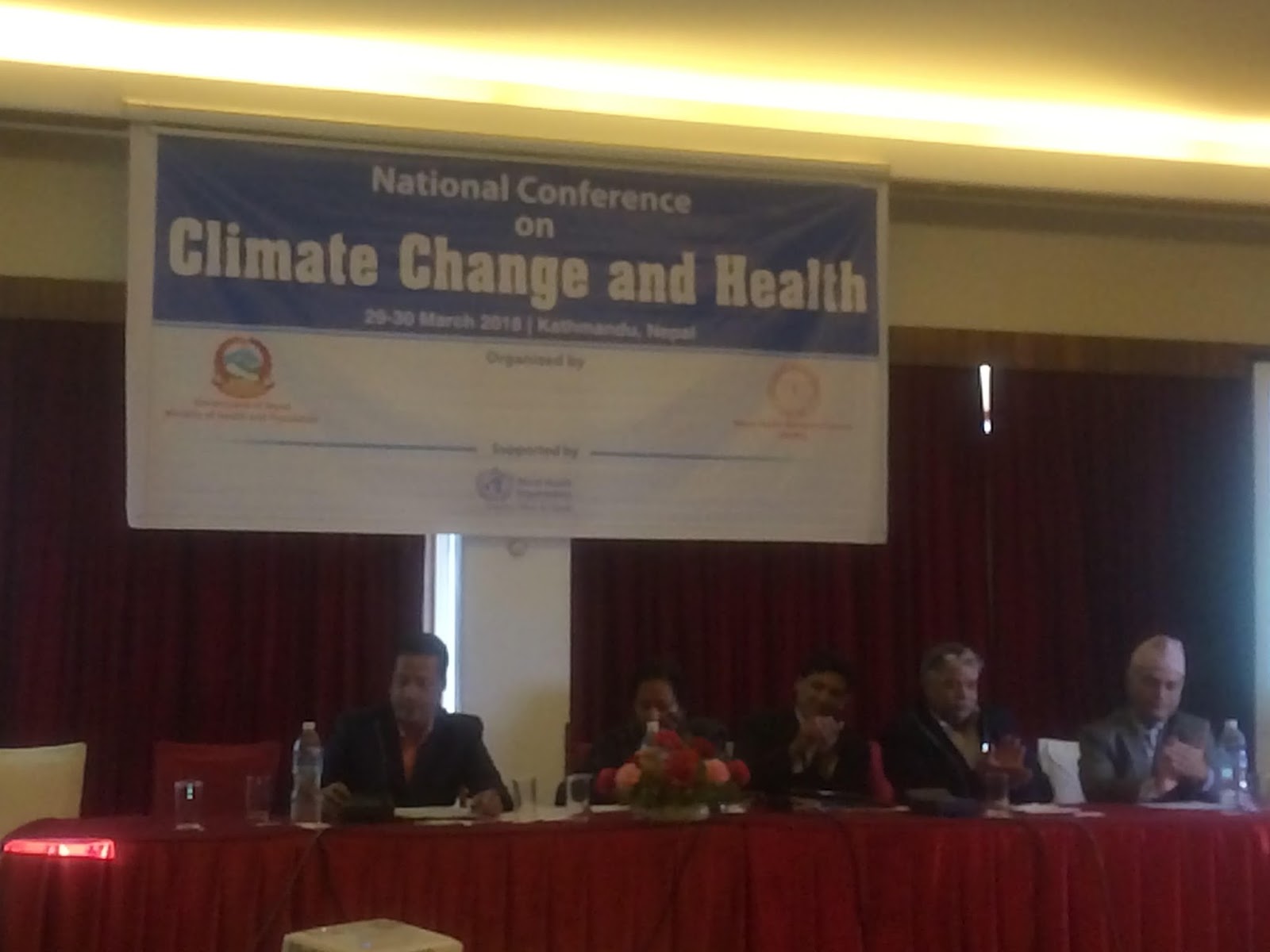
Learning from National Conference on Climate Change and Health (CC - Health) , Kathmandu Post 14 / 24 (Feb 2018)


Climate change and its uproar all over the globe is getting louder than ever at every front, be it academic, scientific, or political as well as environmental communities. When it comes to Nepal, we are situated in such a climate sensitive geographic Himalayan region, we are affected with adverse events related with climate change never felt before couple of decades ago. With this noise that is heard and read in everyday newspaper, Ministry of Health and Population (MoHP) and National Health Research Council (NHRC), Nepal organised 2 days conference with a financial as well as technical support from World Health Organisation (WHO) country office Nepal.

Technical Session in progress at the conference (Photo Credit - Anuj Bhattachan)

As anybody else, I am always interested in listening to what chief guest and other distinguished delegates have to say on the subject that directly or indirectly affects people's livelihood on the ground. In the inaugural speech,  Dr. Bhola Ram Shrestha, Chief Curative division, at MoH said that "climate change and its affect on health is currently felt everywhere and particularly, the affect is felt the most in low income countries like Nepal. As a result, there are various negative consequences like reduction in agricultural productivity, increase in infectious diseases (even generation of new microbes). It is reported that 23 % of deaths worldwide are now related with climate change, which is a complex interaction of several environmental factors with increasing negative impact disproportionately affecting health of people living in low income countries. Noteworthy, the progressive increase in ambient temperature results in decreasing productivity of labor and thus affecting local as well as national economics. Next question that arise in this conversation is how to quantify these impacts in human health or in agriculture sectors? Therefore, there is acute need to generate data that measure and track progress and effects, enabling us with enough scientific evidence(s) for policy decision making in the ministry. Instead, if we lose track of what we need to do for future generation in climate change sector, there will be an irreversible cost to human lives. In this respect, our government is committed and working on national adaptation to climate change. Also, the recent Male Declaration will be an important document that guides us in carrying out climate change related research, in designing climate change adaptation plan in our South Asian context. 

The Mr. Tej Raj Bhatt, DG, Department of Water, Sanitation and Sewage (DWSS) said that "looking from climate vulnerability lens  – we are vulnerable to CC – and its consequences on health of the people. He stressed that DWSS is committed in working to tackle CC and there is climate change section for carrying our research  and contribute in formulating adaptation plan under ministry of environment. The WHO representative, Dr. Jos Vandelaer said that CC is not a new issue, whereby many studies have reported that increase in temp, erratic and intense rainfall, more frequent natural disaster/ extreme changes are ongoing phenomena. CC is a biggest threat to health of people and thus bringing economic change mainly through food insecurity. Undoubtedly, Nepal is the most vulnerable  as a country in terms of CC - Health.  DFID grant is also working on disease surveillance looking into climate sensitive indicators. Therefore, there is an expectation from WHO,  what is next step? and way forward to mitigate climate change and its effects on health in Nepal. 

Dr Shushil Pyakurel, Chief Specialist, MoHP illuminated all of us with his decades of public health experiences. He said that drying of water sources, a common observation throughout far west, has led to increasing trend of migration. The key reason is the increasing deforestation, which has affected farming and thus local economics. Another grave concern is the increasing trend in morbidity, mortality, disability related with vector borne diseases. He said, therefore, there is a need to explore and enforce strict rules regulation that bind transportation sector and industries (brick / cement). Also, there is increasing infrastructure development work, this also needs regulation so there is no negative environmental consequences. The is also need for inter country collaboration. 

Ms. Padma Kumari Aryal, Honorable State Minister, MoHP said in her inaugural speech that the climate change and its effect on health is government’s high priority and expect result oriented outcome from this conference. The is also a need for national as well as international collaboration and effort to jointly tackle CC – Health. Minister also stressed that there is an increasing reports of disasters (flooding/ landslide/glacier river), which are affecting directly the livelihood of communities. This is therefore a sensitive subject matter and only policy is not enough,  what we need is its real implementation with close coordination/collaboration with local government and communities, while we can’t neglect international support and collaboration. 


First day

Technical Session I
  • Climate change in Nepal: Observed trends and future scenarios
  • Overview of climate resilient health system
  • Overview of health impacts of climate change in Nepal
 Technical Session II
  • Impacts of climate change on WASH
  • Effectiveness of HH and community level WASH interventions in reducing health vulnerability to climate in Dolakha
  • Effects of climate change on diarrhoeal diseases at national and sub-national level in Nepal

Second day

Technical Session III
  • Gender perspectives on the health impacts of environmental and climate change in Nepal
  • Climate change policy and financing in Nepal
  • Health Sector response to climate change in Nepal 


Kathmandu
31 March 2018

Anuj in Himalayas

Hi i am connecting disqus with my blog for healthy interaction and open dialogue